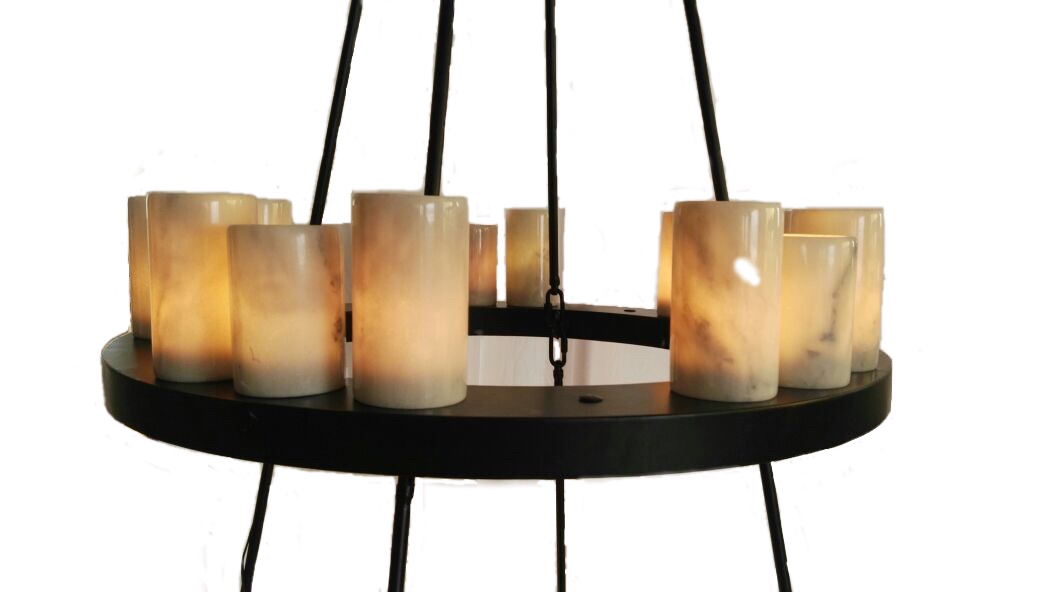
The earliest candle custom chandeliers were used in medieval places of assembly. They generally took the form of a wooden cross with a number of spikes on which candles could be secured, the whole assembly being hoisted to a suitable height on a rope or chain suspended from a hook.
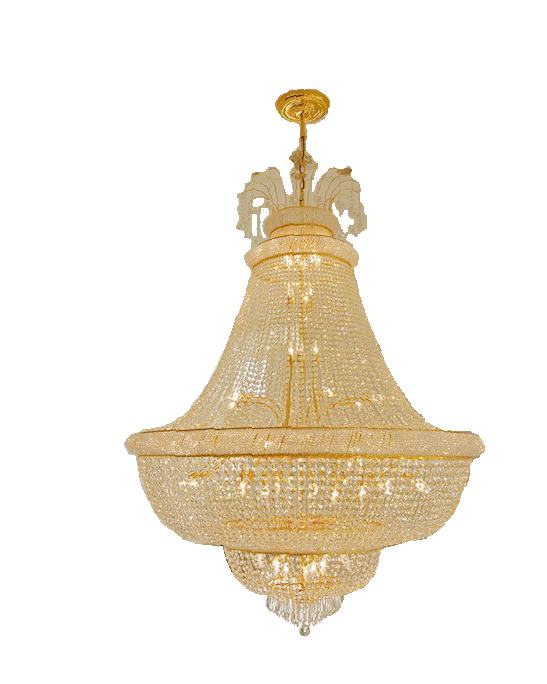
From the 15th century, more complex forms of chandeliers based on ring or crown designs began to become popular decorative features, found in palaces and homes of the nobility, clergy and merchant class. The high cost of night time illumination made the chandelier a symbol of luxury and status. By the early 18th century, ornate cast ormolu forms with long, curved arms and many candles could be found in the homes of much of the growing merchant class. Neoclassical motifs became an increasingly common element, mostly in cast metals but also in carved and gilded wood. Developments in glassmaking in the 18th century allowed the cheaper production of lead crystal. The light-scattering properties of this highly refractive glass quickly became a popular addition to the form, leading to the crystal chandelier.
In the nineteenth century, as gas light became a source of illumination, branched ceiling fixtures were produced, and the term gasolier, a portmanteau of gas and chandelier, was frequently used. Gas illuminated
chandeliers
appeared in the mid-19th century, and many candle chandeliers
were sometimes converted to gas. By the 1890s, and the appearance of electricity for illumination, chandeliers were produced that used both gas and electricity. As distribution of electricity became wider, and the supply dependable, fixtures wired only for electricity became standard. -
Information from : Wikipedia
Tel: 201-486-5767 FAX: 201-836-8557 | INFO@PRESTIGECHANDELIER.COM PRESTIGECHANDELIER@GMAIL.COM |